

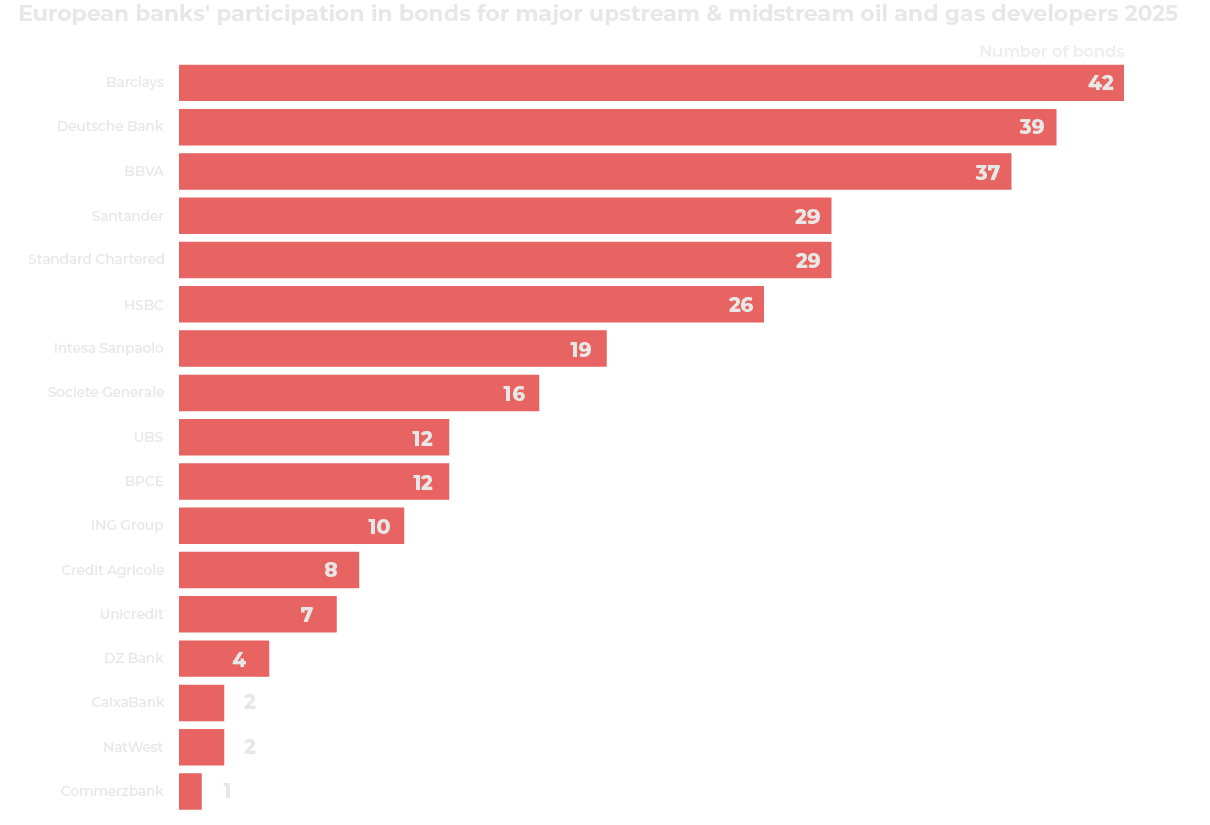
Between 2021 and 2025, 19 of the largest European banks facilitated the issuance of 216 bonds from the capital markets for companies developing new upstream and midstream oil and gas projects, helping them to raise €219 billion. 2025 has been the year in which European banks participated in the largest number of bond issuances for these companies, despite the finding of the International Energy Agency that no new oil and gas fields are needed in scenarios that limit global warming to 1.5°C. The five European banks that facilitated most bond issuances for major oil and gas developers in 2025 were Barclays, Deutsche Bank, BBVA, Santander and Standard Chartered. Banks must discontinue their financial support to companies expanding their oil and gas operations, both through lending and capital market activities (CMAs) along the whole value chain.
The bond market has become a critical source of financing for the world’s most polluting companies. The Banking on Climate Chaos report found that over the past decade, the share of bonds in the funding strategies of fossil fuel companies has nearly doubled and that in both 2023 and 2024, 51% of bank finance for companies involved in fossil fuel expansion was raised through corporate bonds. By facilitating bond issuances, banks play a critical role in enabling fossil fuel companies to raise the capital necessary to further develop their operations. European banks are no exception.
European banks bonding with oil and gas expansion
Reclaim Finance analyzed the participation of the 24 largest European banks in bonds issued by over 30 of the largest upstream and midstream oil and gas developers between 2021 and 2025 (1). 19 of these banks participated in bonds issued during the period analyzed. They were involved in 216 bond issuances, helping some of the world’s worst polluters to raise a total of €219 billion from the capital markets.
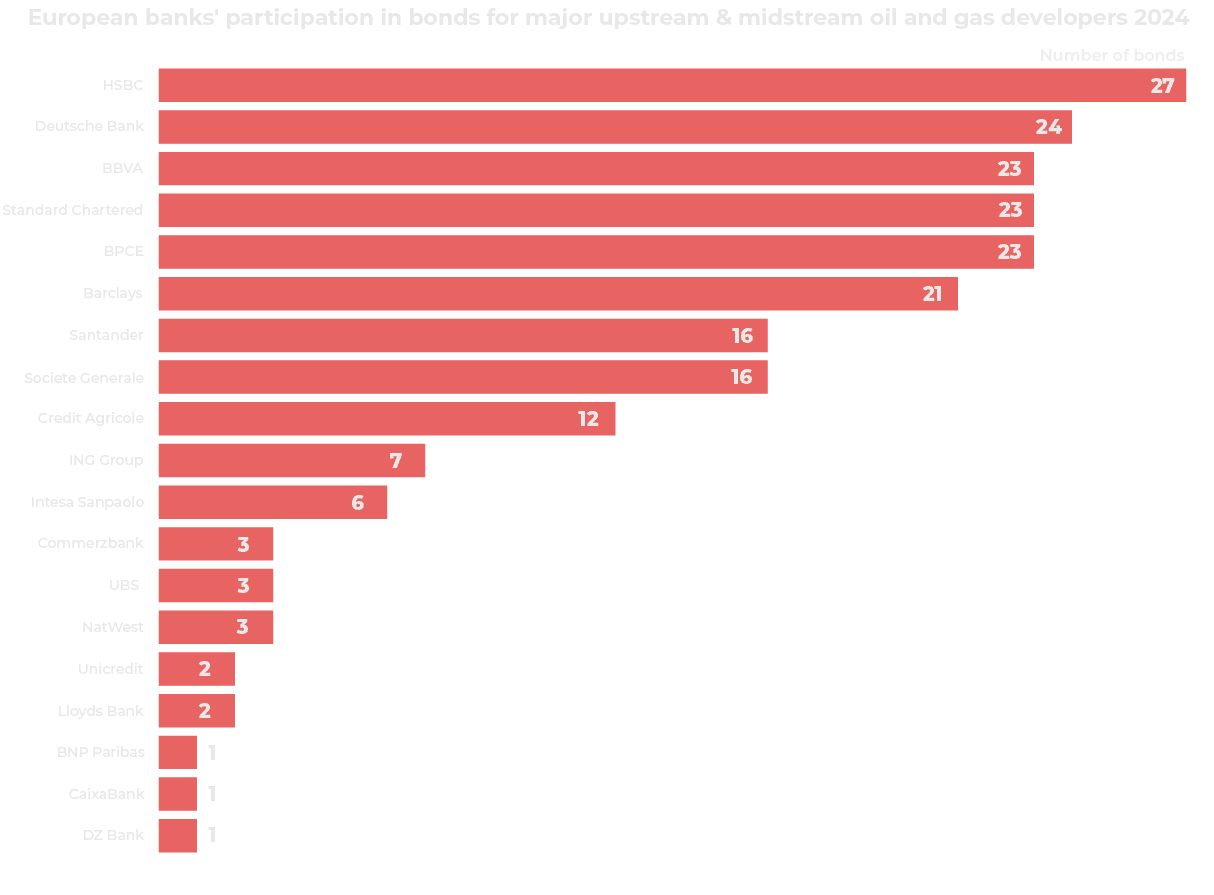
Since 2022, the number of bonds issued in which European banks were involved has increased steadily and sharply. In 2025, European banks participated in the highest number of bond issuances since 2021, helping to raise €60 billion for the companies analyzed. Last year has thus been the second-largest year after 2024 in terms of total bond financing volume since 2021.

Among European banks, Barclays participated in the highest number of bond issuances in 2025 (42), through which major oil and gas developers were able to raise a total of €32 billion on the bond market. Among the companies profiting from Barclays’ support is Energy Transfer, the developer of the Dakota Access Pipeline (DAPL), which became notorious due to the strong mobilization of the Standing Rock Sioux and their supporters against the pipeline and the violence against them. Energy Transfer is behind a SLAPP suit against Greenpeace, and the company’s CEO, Kelcy Warren, has donated millions of dollars to all of Donald Trump’s electoral campaigns (2).
Closely following Barclays in terms of the number of bonds and the volume of finance raised through those bonds for major oil and gas companies in 2025 are Deutsche Bank, BBVA, Santander and Standard Chartered. In 2024, Deutsche Bank, BBVA and Standard Chartered were also amongst the top 5, accompanied by Banque Populaire Caisse d’Epargne (BPCE)’s corporate investment bank Natixis, and HSBC.
Capital Market Activities: European banks’ climate policy blind spot
While most major European banks have targets that would supposedly reduce their lending to oil and gas companies (“financed emission targets”), only three — Standard Chartered, Barclays and HSBC — have targets that cover their facilitation of bond and equity issuances to oil and gas companies. Barclays and HSBC aggregate their lending and facilitation activities into combined targets. Standard Chartered has taken the better approach of separating these targets, which supports transparency and promotes efforts to reduce both forms of finance.
The formula used to calculate “facilitated emissions” unfortunately makes it an inappropriate metric for setting capital markets targets as it does not provide a direct link between changes in facilitated emissions and in real-world corporate emissions. The formula attributes corporate emissions to banks using a fraction which divides corporate emissions by corporate value. This means that a bank’s facilitated emissions will decline as corporate values increase, even if real-world emissions stay constant or even rise slightly (3). The formula for calculating “financed emissions” from loans and investments suffers from the same flaw when used to set targets (4).
Recommendations: corporate exclusion policies & impactful decarbonization targets
In 2024, Crédit Agricole and BNP Paribas both committed to no longer participating in bond issuances by oil and gas producers. BNP Paribas does not appear in bank syndicates for bonds issued by the companies analyzed for 2025 and so appears to be complying with their policy. Crédit Agricole appears in several 2025 bond issuances by midstream oil and gas developers, including Energy Transfer, exemplifying the need for the bank to extend its commitment to the midstream sector, as well as applying this commitment to their direct lending activities to demonstrate the sincerity of their commitment.
BNP Paribas’ and Crédit Agricole’s commitments set an example for other banks to follow, but all of them must go further. The International Energy Agency’s projections show that opening up new oil and gas fields is incompatible with meeting the 1.5°C target, and that energy needs can be met without these new developments (5). Therefore, banks must stop financial support for all companies expanding their oil and gas operations, including Liquified Natural Gas (LNG), through lending and capital market activities.
Additionally, both lending and capital markets targets should aim to reduce the volume of financing provided to O&G companies, not their financed or facilitated emissions as normally defined. To date, only BNP Paribas, Crédit Agricole, Société Générale, and ING have adopted such “sectoral portfolio financing volume” (SPFV) targets. These SPFV targets currently apply only to banks’ credit exposure and are limited to the upstream part of the value chain. They now need to be applied to CMAs as well, and to the value chain in its entirety.
As this analysis has shown, it is urgently necessary that banks effectively address the emissions linked to both their lending activities and CMAs, including the bonds they structure for oil and gas developers. SPFV targets should serve banks as a blueprint to set targets to reduce the volume of their financing for oil and gas companies provided via the capital markets, in addition to exclusion policies for financial support to oil and gas developers that cover loans, bonds and the entire value chain.


