
Supporting the decarbonisation of the steel sector

Limiting global warming to 1.5°C requires ending the world’s reliance on fossil fuels. This can only be done by adopting comprehensive approaches that tackle both fossil fuel production and their consumption by demand-side sectors, such as the steel sector.
From buildings, to cars, to domestic appliances and other equipment, steel is virtually omnipresent in our modern world. The quantity of steel used globally was estimated at 209 kg per person in 2025. Steel is also an essential part of the energy transition as it is used to build infrastructure and products such as wind turbines, solar panels, and electric vehicles.
However, current ways of producing steel are heavily carbon-intensive due to their reliance on coal – also called metallurgical coal (met coal) when used in steelmaking. Decarbonizing steelmaking while meeting demand with cleaner and competitive alternatives is possible and must become a priority.
The decarbonization of steel production will only be possible if financial institutions step up to finance the right solutions. They must urgently refuse to perpetuate the steel sector’s reliance on coal and finance cleaner technologies instead.

Debunking 10 steel decarbonization myths
Insights for financial institutions
The steel industry, long considered “hard-to-abate” due to its reliance on metallurgical coal, can now decarbonize faster thanks to technological advances. However, financial institutions remain slow to act, hindered by misconceptions about the cost and feasibility of decarbonization. Steel accounts for 11% of global CO2 emissions, and with demand expected to rise and aging facilities, the next six years are crucial for transforming production. The goal of this briefing is to dispel the common myths that financial institutions hold about steel decarbonization and the role of metallurgical coal.
How steel is made
Today, there are two main ways to produce steel. Most of the emissions from steel come from manufacturing steel from raw materials, using metallurgical coal and iron ore. This is known as primary steelmaking. It is for the most part done using the blast furnace-basic oxygen furnace route (BF-BOF), that still accounts for 66% of global steel production and is responsible for 88% of the steel sector’s total CO2 emissions.
Steel can also be produced by recycling scraps of steel. This is known as secondary steelmaking, and uses electric arc furnaces (EAF). This route is seven times less carbon-intensive than primary steelmaking, and even more so if it runs on clean sources of electricity, but it is highly dependent on scrap availability and quality.
Many current steel facilities are nearing the end of their lifetime. With major investment needed, this is an opportunity to shift to cleaner technologies to produce steel. Getting it wrong would be fatal as it would mean the development of coal-based capacity, which, with a lifetime of around 20 years, would lock in emissions for decades, ruining any hope of decarbonizing the steel sector in time to reach net zero by 2050.
“The current pipeline of projects clearly nonetheless falls short of what is required to meet the Net Zero Scenario.” International Energy Agency, 2023
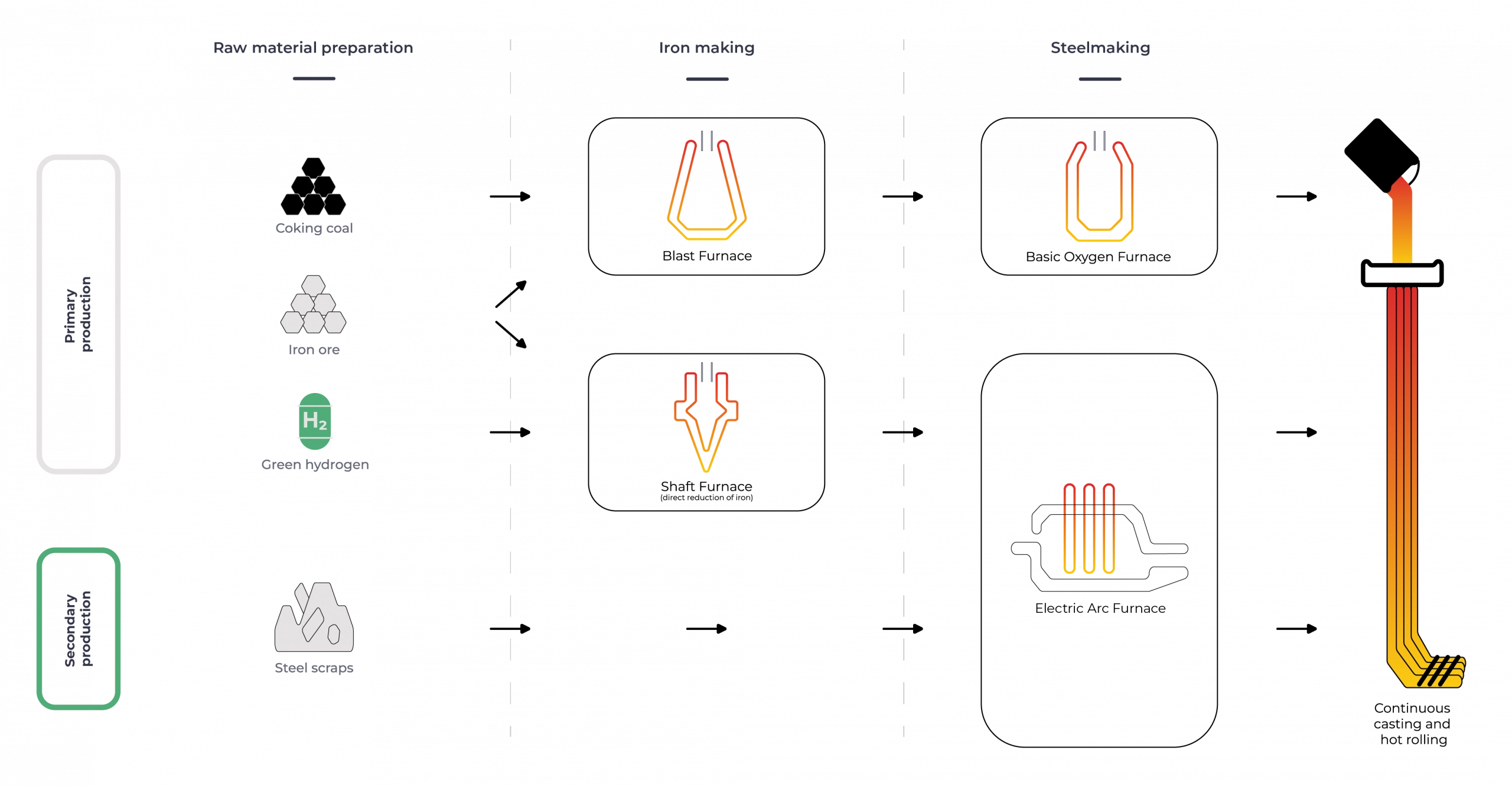
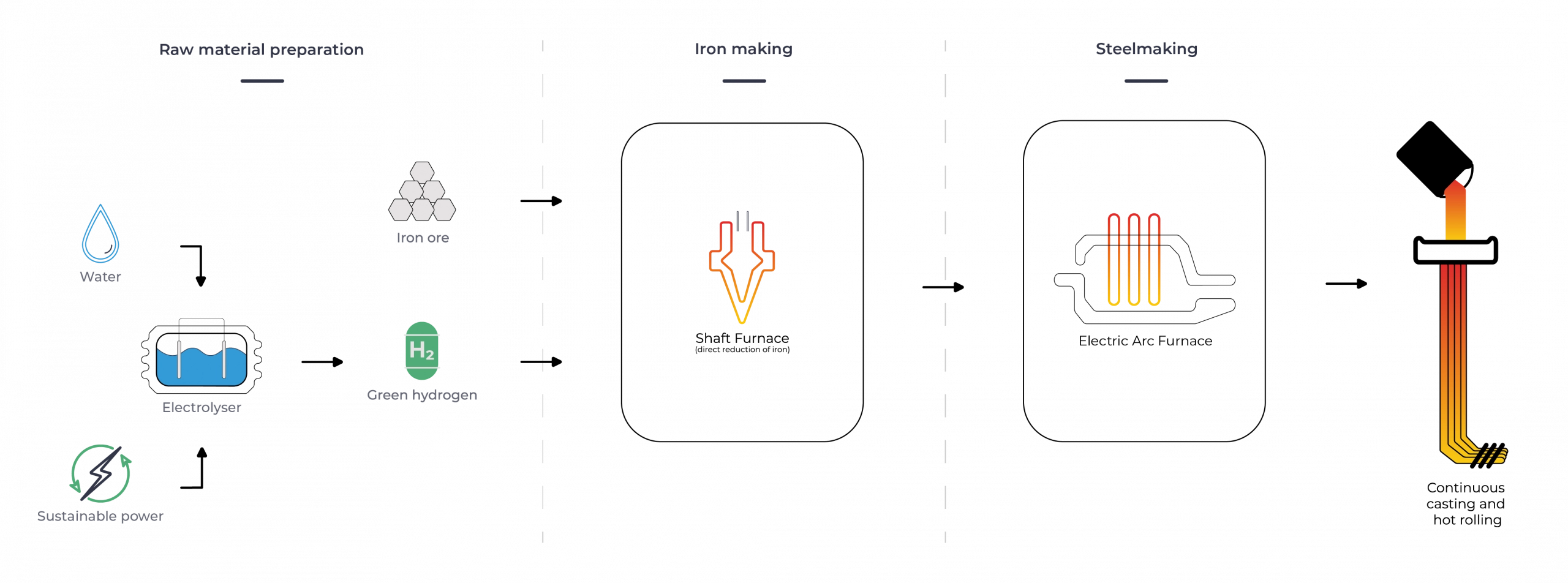
Less carbon-intensive ways of producing steel exist or are in development. Recent technological advances, especially using green hydrogen to reduce the iron (Direct Reduction of Iron, DRI), make it possible to entirely rid the steel sector of coal by the mid-2040s. This implies that green hydrogen must be prioritised for so-called “hard-to-abate” sectors where it represents the best option for decarbonization. Increasing the availability of sustainable power sources for steel facilities is also key to decarbonizing the sector.
Decarbonizing steel: time is of the essence
of global CO2 emissions produced by steel.
Due to its reliance on coal, the steel sector produces 8% of global GHG emissions and 11% of global CO2 emissions.
Decarbonising the steel sector is key to limit global warming. In the EU, the steel industry accounts for 5% of all CO2 emissions and would need to cut emissions by 55% by 2030 to align with Europe’s climate targets. Similarly, to achieve the International Energy Agency’s Net Zero Scenario, the global production of metallurgical coal would need to fall by about 30% by 2030, and by 88% by 2050, based on 2021 levels. This requires a 100-fold increase in production using cleaner steelmaking technologies to happen by 2030.
Yet, in many parts of the world, steel projects are heading in the wrong direction. Research by Global Energy Monitor shows that although EAF-based capacity makes up 50% of all projects in development, less than a third of these projects have reached the construction phase. On the other hand, coal-based production continues to grow. BF-BOF represent 40% of steelmaking capacity under development. And blast furnaces with a total capacity of 80 million tons of steel per annum are planned for relining, meaning their lifespan will be extended for another 15 to 20 years.
There is an urgent need to increase financing to develop and deploy alternative technologies that now exist, such as DRIs using hydrogen made from renewable electricity.

Steeling our future
The banks propping up coal-based steel
The iron and steel sector has a heavy climate impact, accounting for 11% of global CO2 emissions. Decarbonizing the steel sector is key to respond to the climate emergency. The climate impact of the steel sector is primarily due to its reliance on metallurgical coal for its production. Indeed, almost 90% of steel sector emissions are attributed to the coal-based route. As new technologies that do not rely on metallurgical coal develop, studies show that coal can be phased out of steelmaking in the early 2040s. This requires immediate action from banks.
ArcelorMittal – from leader to laggard
As one of the biggest steelmakers in the world, ArcelorMittal has a key role to play in decarbonizing the steel industry. However, as it stands, the company has not delivered on its own climate strategy and has even gone backward on the targets and trajectory it had set in 2021.
As analysed by SteelWatch in its latest ArcelorMittal Corporate Climate Assessment, “the company has revised its group-level emissions intensity reduction target for 2030 from 25% to 10%, while the previously stated Europe-specific target of a 35% reduction has disappeared altogether.”
Apart from the project to set up an electric arc furnace in Dunkirk (France), no further decarbonation investment decision will be made before the EAF is operational after 2030. Between 2021 and 2025, just 1.1 billion USD has been directed toward decarbonation, out of 19.8 billion in total capex, while 12 billion USD have been spent in delivering shareholder returns. Despite the 3.6 billion euros of public subsidies received by the company for decarbonation, its current pace of action makes it impossible for ArcelorMittal to reach any climate targets and to make any progress commensurate with the urgent need to cut emissions.
In addition to its constant failure to act on climate, ArcelorMittal faces criticism for the impact of its activities on human rights and populations in many countries, including Mexico, Liberia, and South Africa. This involves indigenous and tribal communities losing control over their lands, waters, and forests, while impoverished neighborhoods face ongoing pollution that damages their health and limits their livelihoods.
Financial institutions must push steelmakers towards decarbonization
The first step for financial institutions is to stop supporting any new metallurgical coal mines, expansion plans, or new coal-based steelmaking projects, expansion projects, or the relining of blast furnaces.
The second step is to make any new financial service to clients and investee companies conditional on a commitment to stop developing such facilities, and to engage steelmaking companies to invest in the right technologies, across all geographies.
Financial institutions increasingly voice their discontent at climate action that is limited to the supply of fossil fuels. However, they are yet to adopt policies to address demand-side sectors. Their coal policies mainly target thermal coal, mostly due to the false belief that there are no alternatives to metallurgical coal. Today, only 12 major financial institutions have adopted an exclusion policy for met coal, and most of them only cover the project level, when almost all of the financing occurs at the corporate level. It therefore leaves the door open to finance companies carrying out the 273 metallurgical coal expansion projects currently underway – like Glencore, BHP, Mitsubishi, and AngloAmerican – which would increase global metallurgical coal production by 50%.
Financial institutions must urgently adopt policies that restrict financing for companies developing new met coal projects, and steelmakers planning new blast furnaces or the relining of existing blast furnaces. Coal is coal, it must be phased out regardless of its end use, especially considering that the line between thermal and metallurgical coal is not as clear as it seems, as records of companies selling “steelmaking coal” to be burned in power plants are emerging. Fortunately, alternative technologies now exist and can be developed and deployed if the necessary financial resources are made available. This involves financing green-hydrogen ready facilities, and supporting the development of enabling factors like sustainable power. This is an opportunity for financial institutions to back up their words with action.


