

A year after the closure of the Net-Zero Banking Alliance (NZBA), most of its former members have kept their climate targets. Only three banks have dropped them entirely. Our updated targets tracker now includes, for the first time, banks’ reported progress at meeting their targets. Most 2025 targets seem to have been met, but only just over half of the far more numerous 2030 targets are on track. Furthermore, much of the apparent progress reflects flawed target design, weak ambition and, especially for oil and gas, soaring corporate valuations, rather than real-world emission cuts. Banks need to overhaul their targets.
Reclaim Finance has updated our tracker on the climate targets of 33 major banks to include, for the first time, annual progress at meeting them. A briefing explains some of the main trends seen in the progress data. The setting of targets by banks for the most carbon-intensive sectors were the main achievement of the NZBA, which was shut down in October 2025. (1)
A year later, only Wells Fargo, RBC and Scotiabank have scrapped all their targets, while NatWest, Santander and UBS have dropped at least one. Every other bank has kept its targets, and ten have added new ones. The tracker now has 326 active targets, only 25 fewer than in 2024.
Progress is not what it seems
Progress is mixed: most of the small number of 2025 targets seem to have been met (10 out of 15 targets for which data is available to make an assessment), but only just over half of the 261 targets for 2030 are on track or already exceeded.
A lack of transparency makes it impossible to assess progress for around a tenth of 2030 targets. It also hides which companies are included under specific targets and how these change as bank sectoral portfolios evolve, as well as what those companies emit.
Many targets appear to be on track due more to low ambition and/or poor design than to bank efforts to decarbonize their portfolios. That 23% of 2030 targets have already been met, five years early, suggests banks did not set strenuous targets.
Where bank sectoral portfolios show falling emissions this likely often reflects the falling emissions intensity of these sectors rather than any bank action. The share of 2030 targets on track or already met ranges widely (see Figure 1), from 83% in power generation — likely due mostly to booming solar and wind — to just 13% in shipping, where decarbonization has been limited.
Progress at meeting 2030 sectoral targets
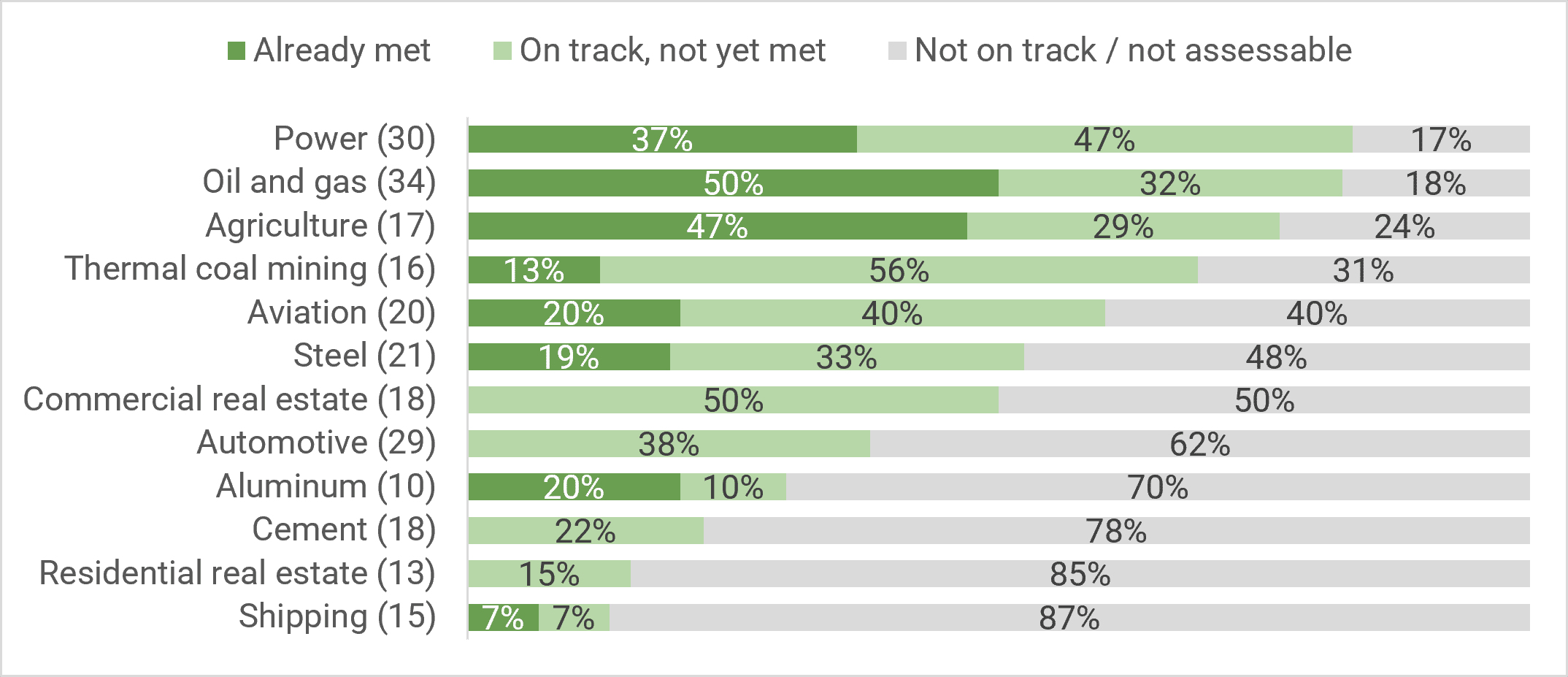
Notes: Number of active 2030 targets in brackets. Excludes dropped targets and sectors with four or fewer targets. Oil and gas targets exclude 1 oil-only and 1 gas-only target and 3 targets that include coal along with oil and gas. Percentages for each sector may not total 100% because of rounding.
Oil and gas: targets met while emissions rise
There is a yawning gap between target progress and real-world emission trends for oil and gas. Half of the sector’s 2030 targets have already been met, and 83% are on track. Yet global oil and gas emissions rose between 2020 and 2025. (2)
The explanation for this gulf between apparent and real emission trends is that a majority of oil and gas targets are based on financed emissions (from lending) or facilitated emissions (from capital markets issuances) (see Figure 2). These “attributed” emissions are calculated by multiplying client emissions by an attribution factor with corporate value as its denominator. (3) When oil and gas company valuations soar, as after Russia’s attack on Ukraine in 2022, a bank’s attributed emissions will fall even if it provides the same amount of financing to the same companies producing the same volumes of hydrocarbons. (4)
Progress at meeting 2030 oil and gas targets, by type
| Metric type | No. of targets | No. on track | % on track | No. met | % met | Avg. targeted reduction from baseline |
|---|---|---|---|---|---|---|
| All types | 36 | 30 | 83% | 19 | 53% | 34% |
| Absolute financed/facilitated emissions | 19 | 19 | 100% | 16 | 84% | 35% |
| Physical intensity | 12 | 6 | 50% | 0 | 0% | 25% |
| Credit exposure | 5 | 5 | 100% | 3 | 60% | 49% |
All 19 absolute financed/facilitated emissions targets are on track, and 16 have already been met. By contrast, only half of the physical intensity targets, which track real emissions per unit of energy, are on track, and none has been achieved. (5)
BNP Paribas, Société Générale, ING, and Rabobank have set targets to cut credit exposure to oil and gas companies. (6) The targets of the first three cover companies in the upstream part of the value chain; Rabobank covers oil and gas trading. All are on track, including the minus 80% targets from BNP Paribas (oil only) and Société Générale (oil and gas), which stand out for the size of the exposure reduction targeted. This progress presumably reflects real lending cuts, although the companies covered have not been disclosed. None of the four banks discloses how it defines upstream companies or whether integrated oil and gas companies, including the oil majors, are included. (7)
Coal targets
Fifteen banks have 2030 targets for thermal coal mining. (8) Of the 16 targets (SMBC has two), 11 are on track, one is not, and four cannot be assessed.
Ten of these targets aim to zero out lending exposure by the end of this decade, at least for companies based in the EU and/or OECD. (9) Five banks report being on track, with reductions of 63% (MUFG) to 80% (SMBC). BBVA is off track, with a cut of only 21%. BNP Paribas, BPCE/Natixis, Crédit Mutuel and Lloyds have not disclosed sufficient data to assess progress.
The five on-track banks set a positive example to others with targets that are aligned with net-zero by 2050 scenarios, that reduce the capital available to coal miners, and that the banks are taking action to meet.
Gaps in coverage and transparency
Long-standing flaws in target design and transparency remain. Only around one in ten active targets covers capital markets, and just eight banks have any such target. The diversity of target types, baselines and levels of ambition makes it all but impossible to meaningfully compare targets between banks or against decarbonization pathways such as the IEA’s net zero emissions by 2050 scenario.
What banks must do now
Our recommendations remain those of our 2024 report on bank targets. (10) These include:
- Banks should replace attributed emissions targets for fossil fuels with financing volume targets covering credit exposure and capital markets issuances separately.
- Every relevant target should include capital markets, cover all material scopes and gases, exclude carbon credits, and be backed by clear disclosure of methodologies, data quality, and yearly values.
- Targets should be based on pathways that aim to return to 1.5°C, while minimizing the extent and duration of overshoot and reliance on negative emissions, and be linked to transition plans committing banks to actively supporting sectoral transitions.
Download our briefing Much More To Do: A review of progress on bank climate targets
Download our updated target tracker.


